Smart Baby Crib: Reducing Fall Risks of Toddlers Through Image Detection using YOLOv8
An academic system exploring image detection for toddlers from 9 months to 2 years old on constrained edge hardware.
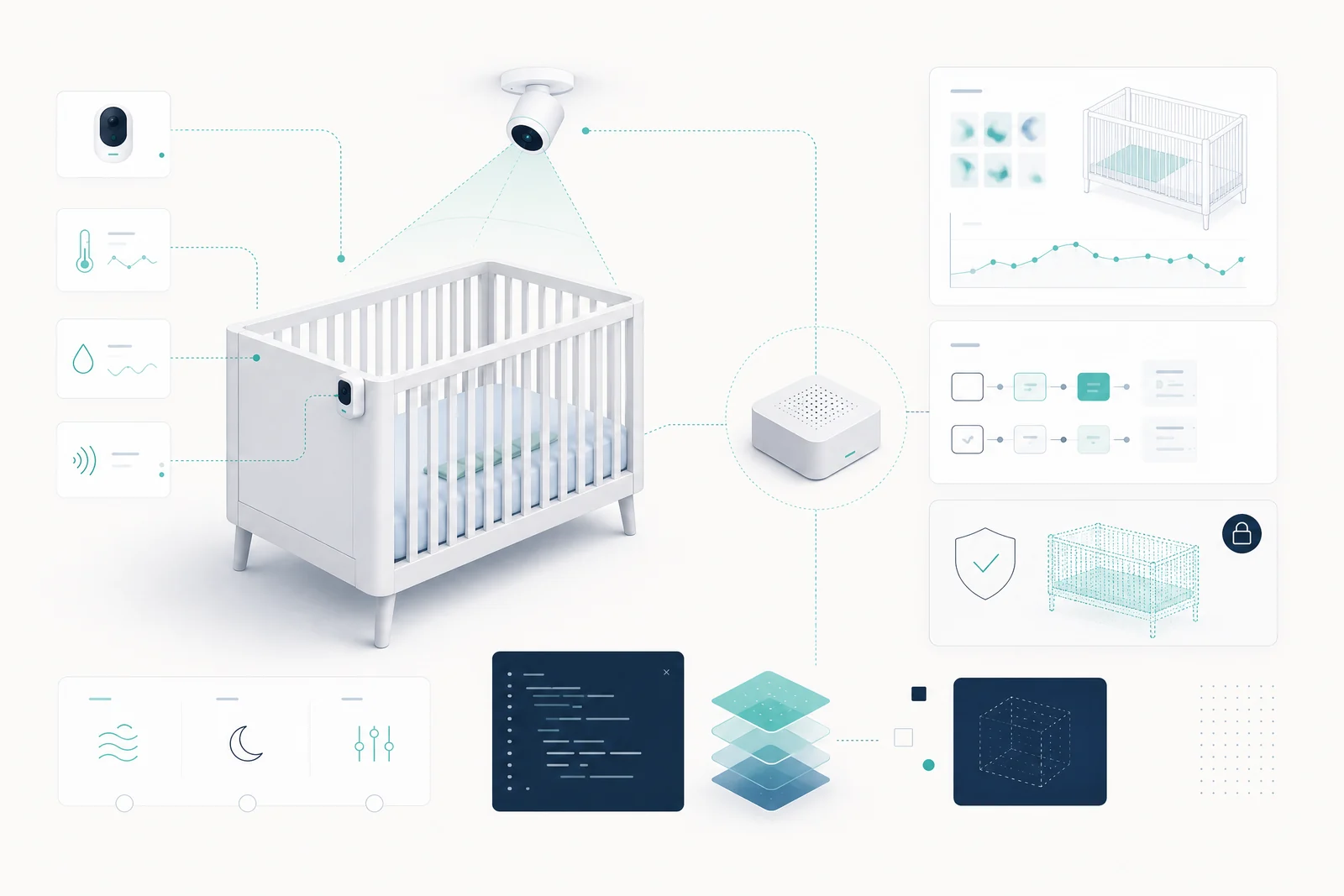
This academic IoT project investigates whether on-device computer vision can support monitoring around a crib without sending every frame to the cloud. It is a technical exploration, not a certified safety product or a claim of production deployment.
The project focused on detecting visual states that may deserve attention and making an alert path available beyond the local device.
- Process a camera stream near the source using a Raspberry Pi 4.
- Explore YOLOv8 detection converted for TensorFlow Lite and Coral Edge TPU inference.
- Expose a monitoring stream through Flask.
- Send an SMS path through a SIM800L module when a relevant detection is handled.
Used in the model-development workflow; no unverified accuracy value is claimed here.
These labels describe the recorded detection classes for the project scope.
Real-time vision is a balancing problem on edge hardware.
Adding bounding boxes and labels to the live stream increased latency. The response was to consider frame skipping, image and detection resizing, JPEG quality, detection intervals, queue depth, and buffer control together rather than optimizing one setting in isolation.
A documented edge-AI pipeline with clear evaluation limits.
The project connects camera capture, local processing, model inference, a web stream, and cellular notification into one technical path. Further work would require controlled test data, failure-mode analysis, measured latency, model evaluation, and hardware reliability testing.
See the software systems first.
ViaNova, ClauseGuard AI, and the AI Executive Assistant show the broader application and automation direction.